


Growing up around Sarplaninacs taught me more about this breed than any book ever could.
These dogs aren’t just pets – they’re serious guardians, and they need to be treated that way.
Nutrition, environment, physical health all of it matters!
I’ll share what I know.
Nutrition
Sarplaninacs are carnivores – meat has to be the base of every meal.
Fresh beef, cooked pork, and boiled chicken give the best results. Bones are a must, but keep fish and small bones out of the bowl.
Cooked vegetables, rice, semolina, bread, and eggs can round out a meal, but meat stays the priority.
If you go with dry kibble, adding yogurt to the bowl makes a real difference.
The first 15 months are critical. This breed grows fast and needs a diet packed with nutrients to keep up with that growth.
Hard physical activity during this period is just as important to avoid as bad food. Rest and free play are what let a Sarplaninac grow into a strong, healthy guardian.
How Often Should You Feed Sarplaninac?
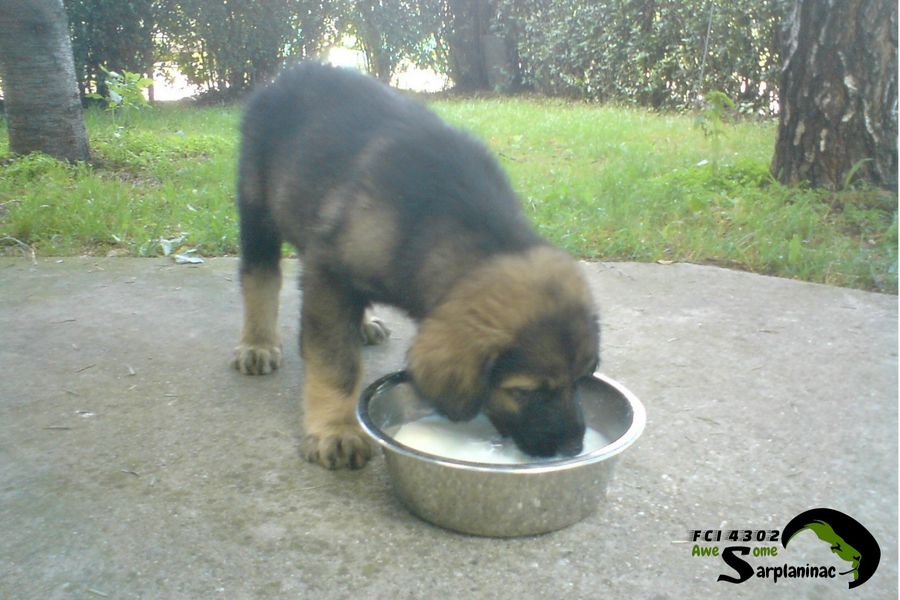
From our experience, Sarplaninac puppies between 2 and 6 months do best on three meals a day.
After 6 months, drop down to two.
Once they hit a year, one meal a day is all an adult dog needs (morning or evening).
Providing Fresh Water
Put food and water bowls outside the play area, ideally in the shade – it keeps the spot clean and the water cool.
Fresh water needs changing at least two or three times a day, and more often in summer.
In winter, take the water bowl away after the dog finishes drinking so it doesn’t freeze or get too cold to drink.

Living Space
The Sarplaninac needs open space – that’s the short answer. A house with a fenced yard is the ideal solution.
These dogs come from the mountains and need room to move and a territory to watch over.
Keeping one indoors means dealing with barking (not every dog will do it). That’s how they guard, and it can quickly become a problem for neighbors, especially at night.
Socialization and training are a must to keep it under control.
Daily walks of at least 30 minutes help burn off energy, and you’ll notice a much quieter dog at home.
Yard vs. Indoor Living
Keeping the Sarplaninac in the yard means a fenced area and a good dog house. Position it so the dog has a clear view of your home’s main entrance.
Seeing who comes and goes lets the dog do its job, and that keeps it calm and alert.
The opening of the dog house matters too. Don’t face it directly north or south – that’s where strong winds and storms come from.
Southwest or southeast is a much better option.
For indoor living, it depends on your home. A fenced-off terrace, a quiet room, or even part of the hallway are all fine, as long as the dog has its own spot where it can rest without being bothered.

Coat and Grooming Tips
The FCI Standard (N° 41) is very specific about the Sarplaninac coat.
The head, ears and front side of the legs are covered with short hair. Around the neck, on the rump, at the rear side of the legs and on the tail the hair is long, almost flat and somewhat coarse. Under the guard hair the abundant undercoat is short, dense and of fine texture. At the withers the hair should measure between 10 and 12cm; it should not be shorter than 7 cm.
Beneath that outer coat sits a dense, fine undercoat that keeps the dog protected from the weather.
Bathing too often is a mistake because it strips the coat of its natural oils. For dogs living outside, a few times a year is enough and for dogs living inside – once a month.
If you’re prepping for a dog show, don’t bathe the Sarplaninac right before the event. Do it at least a month in advance, but personally I’d skip the bath altogether.
Trimming and Brushing
Don’t trim the coat with scissors for cosmetic reasons. Cutting the hair is only justified in special cases like vet procedures or treating an injury.
If your Sarplaninac puppy is born with a fifth claw on the rear paws, talk to a vet about having it removed. These extra claws grow irregularly and cause pain and infections.
Trim the other claws only when they make it hard for the dog to walk normally.
Regular brushing is the most important part of grooming. During spring shedding the coat renews itself, and daily brushing is a must to get rid of dead hair and stop mats and tangles from forming.
In autumn the undercoat gets denser as the Sarplaninac prepares for winter.
Brushing isn’t just about keeping the coat clean. It’s also how you spot hidden wounds, skin issues, or parasites before they turn into bigger problems.
Training and Socialization
Our training covers walking on a leash, heeling, the “place” command, and methods we keep to ourselves. Ring training is also available for those who want to compete.
The goal is a well-balanced dog. We take our young dogs on city walks and to crowded events so they learn to ignore distractions, people, and other dogs.
Don’t take the puppy out before the full vaccination and revaccination process is done.
Bad habits need to be stopped right away. End the play, say a firm “NO” with a clear gesture, or put the dog in a 15-minute time-out in a room or the dog house.
Healthcare
Health starts with the basics: keep up with the dog’s vaccinations and stick to a regular deworming schedule.
Regular vet check-ups matter, but as an owner, you’re the first one who needs to know your dog’s pulse and condition.
On spaying or neutering, my answer is “NO.” After that procedure, the dog is no longer the Sarplaninac. I see them as lovely teddy bears after that, and nothing more.
Yes, it may lower aggressiveness, but how many people can really tell the difference between a biting, aggressive dog and a balanced one? Just because the Sarplaninac won’t let strangers get close or play with them in the owner’s presence doesn’t mean they’re aggressive.
That’s the instinct of a true guardian!
For a female’s heat cycle, keep her in a secure, fenced area for the duration, or use dog diapers if she stays indoors.
One day you might want a litter from your dog, and you should have that option open.

Love and Attention
The Sarplaninac doesn’t need to be petted all the time (being near the family is enough).
Don’t force interaction or games – this is a lazy, dominant dog that makes its own decisions.
Most of the time, the Sarplaninac picks a spot with a clear view of the household and lies down there. Watching the family in silence isn’t boredom – it’s a job.
I see that silence as the strongest sign of a well-balanced dog.


