


Raising a well-balanced dog starts with how you get him used to new things.
Socialization isn’t just about playtime. It is about teaching a puppy to stay calm around new people and places so he doesn’t grow up scared or aggressive.
Without this early training, the puppy can grow up with “bad habits” that are much harder to change later.
We will show you exactly how we build confidence in the puppies we raise.
Our goal is to help you teach the dog to stay calm around strangers, loud noises, and other dogs.
Your Puppy’s First Day at Home
Bringing the puppy home is a huge change for him.
The puppy has a lot to take in. Introduce your family members one at a time, and keep other dogs in another room for now. Make sure the puppy has a quiet space where he can rest and feel safe.
Show the puppy the bed, toys, water bowl …
He needs to feel safe at home before going anywhere else.

What is Puppy socialization?
Socialization means helping the puppy build confidence and get used to new places. It means letting him meet new people and other pets in a positive way.
The goal is to help your dog stay calm wherever you take him (unless there is a valid reason to react).
Before visiting crowded or unfamiliar places, it’s crucial to start in a calm and familiar environment.
This helps him learn through “good experiences” without getting scared.
Meeting Family and Guests
Meeting family and guests is a big part of the puppy’s early training.
When meeting new people, use the leash and collar to stop the puppy from jumping up.
These early meetings help the dog feel comfortable around people and learn to stay calm during greetings.

When is the Right Time for Puppy’s First Walk?
It’s best to wait until the puppy finishes all vaccinations, usually around 16 to 18 weeks.
Puppies are more at risk from diseases like parvovirus, so their health must come first.
For the first few months, your home and yard are the safest places for the puppy to run around.
Once the shots are done, take him to dog-friendly spots like parks and cafés to see new places.
Getting used to new sounds and things around him slowly builds his confidence and makes future walks much easier.
Make sure the first walk is a positive experience.

5-Minute Walking Rule
Finding the right walk length is important for your puppy’s growing bones and joints.
A good rule of thumb is to walk the puppy for five minutes for every month of his age. [1]
For example, a three-month-old puppy needs a 15-minute walk, while a four-month-old should go for 20 minutes.
These times are based on an average of two walks per day.
Of course, you still have to look at the dog’s breed, size, and energy level.
Meeting Resident Dogs
Socializing the puppy means introducing him to the dogs you already have.
Be careful when your puppy meets the dog that’s already there.
Keep both dogs on leashes so they don’t jump on each other and you can stay in control.
Never leave them alone at first! To be safe, start on neutral ground outside if you aren’t sure how they will react.
Once you see they are both curious and friendly, you can let them be together inside the house. Working with a dog trainer helps if you notice any problems.
A bad experience with an aggressive dog can cause a lasting fear for the puppy. [2]
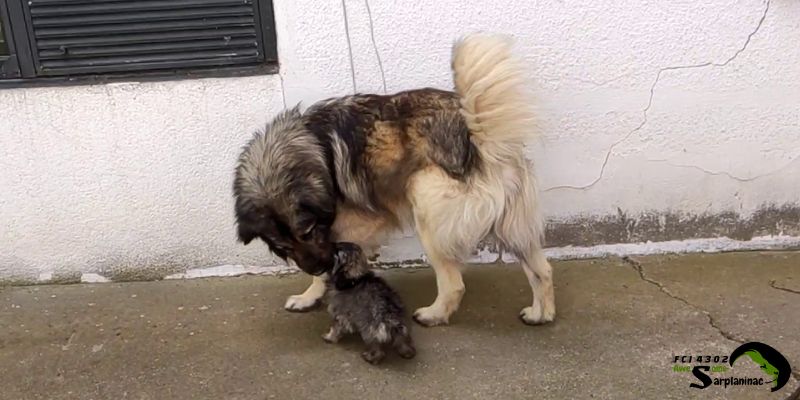
Noise and Confidence
One of the first tests for the puppy is checking his reaction to sudden noises.
A tap on a metal can tells you what you need to know right away. If the puppy is scared, you’ll need patience to help him get past it.
Next, toss a set of keys or jingle them nearby. A bold puppy will head straight for the sound to see what’s going on.
To check for determination, place the puppy in a box they can easily climb out of. This reveals his grit and confidence. [3]
For Sarplaninac puppies, we use firecrackers to test if they stay steady with their tails held high.
Since the Sarplaninac has one main job – to protect what is entrusted to them as a gift – fearlessness is a must for the dog no matter the noise.

Sarplaninac Puppy Socialization
We keep our approach simple by working with the Sarplaninac puppies in groups first, then one-on-one, using everything we’ve learned over the last 36 years.
It all begins with play, leading up to a final video demonstration. These videos show the real progress and give future owners clear steps to continue the training.
Our work covers specific tasks: leash training, guarding an object or a fenced area, moving between village and town, car rides, no fear of sudden or loud sounds, and meeting other dogs.
Tips for Socializing the Puppy
When you take the puppy out, a few simple rules will help you.
- Pick quiet times: Walk the puppy when it’s not too noisy or crowded.
- Protect the joints: Don’t force too much physical activity!
- Check the weather: Make sure the temperature is right.
- Let him sniff: Give it time to look around and build confidence.
- Change your pace: Walk faster or slower to keep him paying attention to you.
- Switch routes: Use different paths for new things.
Adapt the plan to your surroundings and puppy needs.
Conclusion
Socializing the puppy takes patience and consistency, but it is the foundation for everything that follows.
Being a responsible owner means putting in the effort now so you can have a great companion for years to come.
Good luck with your training, and enjoy every step of the way.
Sources:
- Kada štene može u šetnju? Vaša prva zajednička avantura! (more information);
- Kada moje štene može upoznati druge pse? (more information);
- Novi član porodice. (more information).


