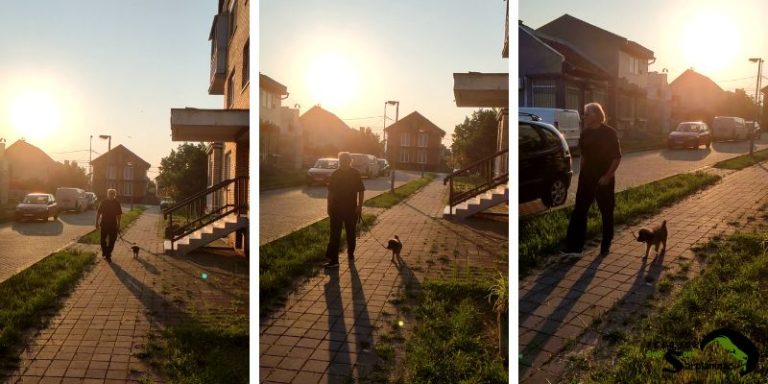
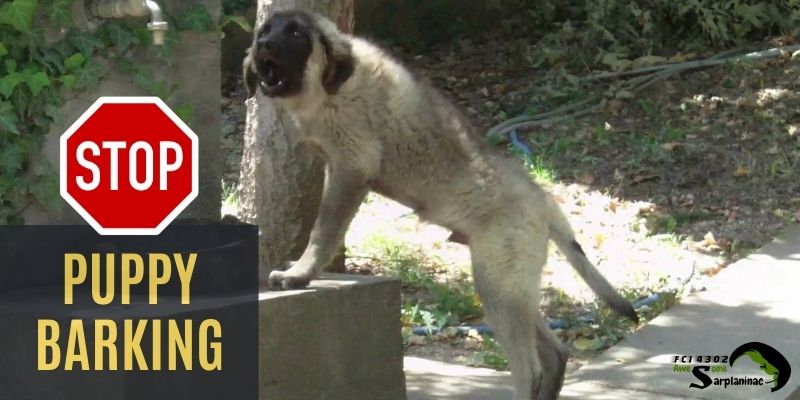

Puppies can drive you crazy in a lot of ways, and barking is usually the worst. When it gets really bad, you can’t even think straight.
Growing up with Sarplaninacs, I’ve seen simple tricks stop the puppy from barking without any punishment.
You just need to know what’s bothering them.
Triggers for Puppy Barking
Barking is how puppies communicate. If you know the reason, training is a lot easier. Here’s what usually causes it:
- Attention and Play: Puppies bark to get you to play, show they love you, or just want attention.
- Fear and Anxiety: New places, loud noises, and strangers can scare the puppy and the barking starts.
- Guarding: With Sarplaninac puppies, I’ve seen this kick in early – someone walks past the yard or there’s an odd sound nearby, and they’re already barking.
- Boredom: Without walks, brain games, or anything to do, barking is the only thing left.
- Hunger, Thirst, or Pain: Needing a potty break, an empty bowl, or something hurting. Puppies bark because they need something and have no other way to say it.

Where Most Owners Go Wrong
A lot of owners make the same mistakes.
Yelling is the big one! – What are you actually achieving?
Ignoring the barking isn’t always the answer either. If the puppy is barking for attention, don’t give it.
But if something is bothering or scaring him, ignoring it just makes things worse.
And if there is a real reason, like someone at the door or a strange sound, telling the puppy to be quiet doesn’t help.
You need to deal with what caused it or give the puppy something else to do.
What We Do When Puppies Bark Too Much
Calming the puppy isn’t about reacting every time he barks.
Watch why he barks. If the puppy starts every time you walk away, he just wants attention.
Fear? Let the puppy get used to new sounds slowly, and don’t rush him. A neighbor walking by or a car door slamming … Small things first.
If he barks for attention, ignore him. No eye contact, no touching, and no talking. Any reaction tells the puppy that this gets results. Wait until he is quiet, then reward him.
The puppies with too much energy? Walks, play, and brain games. Get that energy out of them before they become a problem.
Basic commands like “sit” or “stay” help, but nothing stops it in the moment like a short sound for silance. In our kennel, we use “Psssttt” command. No yelling – just one sign that means stop.

Nighttime Puppy Barking
Most nighttime barking happens because the puppy needs to go out or is still getting used to a new home.
Potty training – a young puppy cannot wait until morning, so take it outside right before bed.
Crate training helps a lot here. During the day, leave the crate open with a toy or treat inside so the puppy starts going in on his own. Once he stops seeing the crate as a bad place, nighttime gets a lot quieter.
For the first few nights, keep the crate close enough to hear the puppy. You need to know if he needs to go out or if he is just testing you.
After a few nights, move the crate to his spot.
Don’t run in every time the puppy whimpers because he knows you’ll show up. If the noise doesn’t stop after a while, take him out for a quick potty break and put him right back in the dog crate. [1]
Why Puppies Bark at Other Dogs
Puppies usually bark at other dogs because they are scared or excited. Fear happens when the puppy feels unsafe around another dog.
The barking is just a defense – back off, stay away.
Being excited is different. That happens when the puppy is on a leash or behind a fence and can’t get to the other dog. He wants to play but can’t, so he barks.
In our kennel, we can tell the difference right away. A confident Sarplaninac and a fearful one don’t bark the same way.
Good temperament shows – the puppy holds its ground, tail up, curious. A fearful one cowers, trembles …
When we see those signs of fear, my father steps in to work with the puppy.
Conclusion
Whatever the trigger is (cat, man, another dog) we use these methods.
Training is about what you do every day. That’s the only way to get rid of this habit for good.
If you have problem, don’t wait. Ask a dog trainer for help.
Every puppy is different and sometimes you need someone who can see exactly what’s going on.
Sources:
- Zaustavite lajanje štenca (more information).