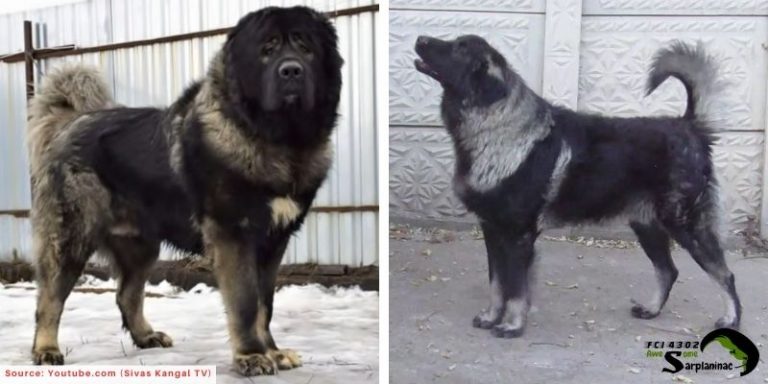


Forget the usual charts showing weight, height, or bite force. Those numbers are easy to find, but they don’t tell you much. I want to talk about how these dogs behave day to day – the things that matter when you’re living with them.
I grew up with Sarplaninac dogs, and I’ve also made videos with Pitbulls and American Staffordshire Terriers alongside ours. That’s given me a closer look at both breeds, not just what I’ve read.
I’m sharing what I’ve seen firsthand – how these dogs behave around strangers, kids, and other animals.

American Staffordshire Terrier vs Pit Bull Terrier
The FCI doesn’t recognize Pit Bull Terrier as a breed, which is why nobody can find one breed standard for it. That’s not about the dogs. It’s about the different kennel clubs and the decisions they made over the years.
Back in 1898, the UKC was the first to recognize the American Pit Bull Terrier (APBT). They don’t have a separate category for the American Staffordshire Terrier. Instead, they allow dogs registered as Amstaffs with the AKC to be registered as APBTs within their registry.
AKC went a different way in the 1930s. They took dogs from the same bloodlines and renamed them American Staffordshire Terriers, to put distance between the breed and the “Pit Bull” name, since that name was tied to dog fighting.
AKC still won’t recognize American Pit Bull Terrier under that name today.
That split created “dual-registered” dogs – an Amstaff in one club is a Pit Bull in another. Breeding for different goals changed how they look over time. AKC Amstaffs usually come out bulkier and more compact, while UKC APBTs lean leaner and more athletic.
Genetic testing shows these are the same dog. What’s different today comes down to what breeders were chasing – show ring looks versus working ability and speed. [1]

Sarplaninac and 2 American Staffordshire Terrier Dogs
My former music teacher recently got a dog named Цар (Eng. “Emperor”).
Watching them together, you could see the kind of trust that only comes from years of being around each other.
Seeing how Emperor followed every move and “kept his eyes on him” gave me the idea to make a video for my YouTube channel.
We headed out to a few spots around the city to see what he could do.
While we were out shooting the video, what stood out most was Emperor’s agility and how high he could jump.
He was well-trained and hit every command without hesitation.
Standing there watching that control, you get a real sense of what this breed’s capable of when trained the right way.

The Second Dog
This second dog is a female that was nearly put down. Someone had trespassed onto her property, she reacted aggressively, and the case actually went to court.
Luckily, a friend stepped in, rescued her, and brought her home.
The real challenge started when she arrived – introducing her to Meda, the Sarplaninac from our kennel.
Our friend worried she might hurt Meda because of her past. That made me smile.
To handle the situation, my father decided to bring them together. The first step was getting both dogs out of their yard and onto neutral ground.
You can see exactly how it all went down in the video below.
Sarplaninac and American Pit Bull Terrier
My father came to my apartment one day with a plan: we were going to make a video with a Pit Bull. I’ll admit, I was skeptical.
At the time, my head was full of the same negative stereotypes you see in the media – aggression, dog fights, and all that.
Local news kept pushing that image with reports of attacks over and over. But I found out fast those stories don’t tell the whole story.
I saw firsthand that these dogs are loyal and stable in the right hands.
My father asked which of our dogs we should bring along, and I suggested a young pup from our kennel.
I had two reasons: first, we had taken some heat for our previous video with Rex (Šarplaninac) and Tyson (American Bully), and second, it was a great chance for socialization.
My Opinion on Pit Bull Terriers
There’s a few things I really like about this breed – that fearless look, plus that explosive speed and agility.
I also love how a collar looks on the Pit Bull! Short hair makes it stand right out.
That’s something I wish we could see with Sarplaninacs, but with those thick coats, it’s just not possible.
On the other hand, one thing I’m not a fan of is the heavy purple pigment around the lips that I’ve seen on some dogs in person.
When it comes to character, having a well-behaved dog is the most important thing. To me, it’s not even about the breed – it’s about the owner and the work put into socialization.
Conclusion
Every dog has the potential to be a great companion. It’s a shame breeds like American Pit Bull Terrier and Sarplaninac get judged unfairly, even banned in some countries.
How a dog behaves comes down to how it’s raised, socialized, and trained by the owner.
Instead of blaming the breed, the focus should be on responsible ownership and education. That’s the only way to prevent problems.
In the end, it’s simple: there are no bad dogs, only bad owners.