
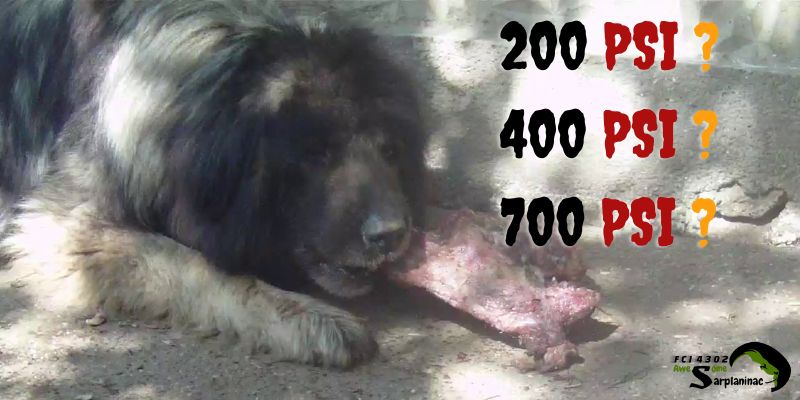

You’ll often see claims that the Sarplaninac has a bite force of 200, 400 or 700 PSI, but these figures are mostly guesswork.
People keep copying and pasting these figures from one site to another without any real evidence.
Having grown up with these dogs, I know what they’re capable of, but there’s no real scientific data for this breed yet.
Here’s where those viral numbers actually come from, and what’s the real truth about their power.
What Does PSI Actually Mean?
Most dog bite force numbers are blown out of proportion because people don’t get the math.
PSI stands for pounds per square inch. It’s a measure of pressure, not raw strength. In a dog’s mouth, that pressure isn’t spread out – it’s packed right onto the tips of the teeth.
One square inch is about 6.5 square centimeters. When a 40kg Sarplaninac bites, all that jaw power hits a spot way smaller than that. That’s why PSI numbers shoot up and get manipulated so easily in online “top 10” lists.
PSI just measures how hard the teeth press into whatever the dog bites. Without knowing the exact tooth surface area and the muscle force from a real test, any “700 PSI” claim is just a math equation with missing pieces. [1]
Flaws in Bite Force Measurements
Scientists use three primary methods to measure jaw pressure.
In Vivo Live testing forces a dog to bite a pressure sensor. While working breeds trained for sports might strike on command, a flock guardian usually bites only under real threat. Without genuine protective drive, the dog rarely exerts its maximum force, making the resulting data inaccurate.
In Silico (Computer Modeling) Digital simulations use Finite Element Analysis (FEA) to estimate force by combining skull structure with estimated muscle data. While these models are useful for comparing species, they rely on mathematical averages rather than the physical reality of a specific dog. A computer can calculate the mechanical limits of a skull, but it cannot account for individual muscle density, current conditioning, or the actual “drive” of a working animal.
In Vitro (Lab Testing) Testing isolated skulls or muscle tissue in a laboratory provides raw anatomical data. However, lab settings cannot capture the adrenaline and dynamic power of a living dog in a defensive situation. [2]
Sarplaninac PSI – Test and Results?
In science, facts are the only thing that matters. Yet, I haven’t found a single scientific study that proves the Šarplaninac’s bite force is XYZ PSI.
We still need answers to basic questions:
- How many dogs did they test?
- How old were they, and were they male or female?
- What was their average height and weight?
- What methods did they use?
- What did they find out?
We still don’t have answers to these questions.
The Kangal is usually at the top of these lists, and because they are popular worldwide, there might actually be real test data for them.
After that, they probably just created 3D models, made graphs, and did math for other dog breeds based on an “ideal type” using the breed standard.
Then big media outlets picked up the story, and “keyboard experts” copy-pasted the data onto their websites without digging deeper, just assuming the info came from reliable sources.
This left the door open for people to label these dogs as predators, beasts, and aggressive – saying they don’t belong in cities and can only be kept “under control” through training.
Shame! That’s not how you do serious scientific research, and labels should not be applied to a breed so lightly.
Look at this picture of our Šarplaninac, Rex. Has a dog like this ever been tested when it comes to this breed?

Leading Internet Portals and Their “Expertise”
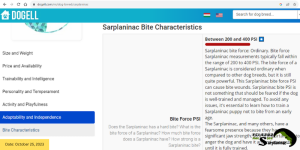
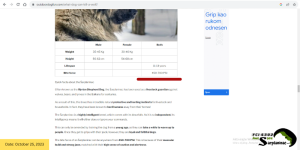
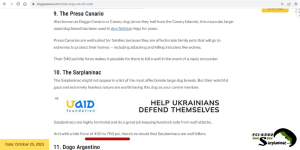
I want to show you what the leading internet portals are writing about the Šarplaninac’s bite force.
They push these numbers as absolute facts, as if they have some secret scientific data that I “and the rest of the world” somehow missed.
But when you look at their “facts,” you see it’s all made up. Every site claims a different number, yet none of them link to a real lab report or a scientific study for this breed.
Conclusion
From the photos I attached, you can see these portals claim the Sarplaninac’s bite force is anywhere from 200 to 700 PSI. But these numbers are unreliable because there is no real science behind them.
It’s the same story with DNA testing for this breed.
I will change my mind only when someone actually answers the questions I asked above.
I know what happened back in the 90s, when some owners and breeders crossed the Sarplaninac with other breeds just to get bigger dogs, heavier bones, and specific coat colors.
Thanks for taking the time to read this!
Sources:
- Top 10: Which animals have the strongest bite? (more information).
- Bite Forces and Their Measurement in Dogs and Cats (more information).


