
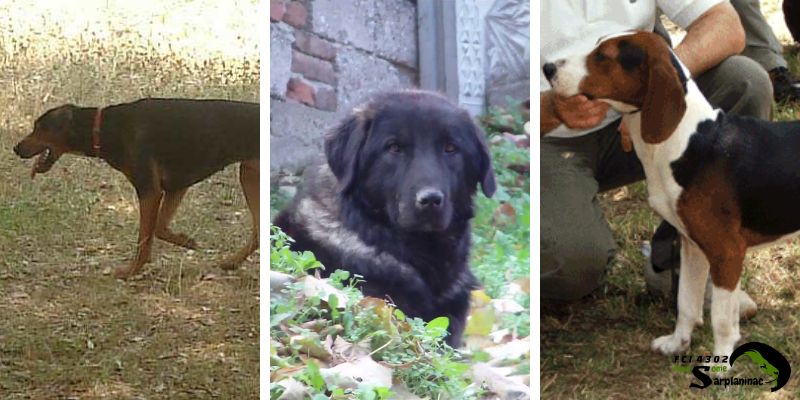

One stays with the sheep, four never stop following the scent. I’ve spent time looking into the 5 Serbian dog breeds that have survived the Balkans for centuries, and I’ve seen how much the “official” records get wrong.
While four breeds are internationally recognized, there’s real disagreement about which other breed earns that spot.
The Cynological Association of Serbia has only listed three autochthonous breeds on its website. [1]
I’m not talking about show dogs or international trophies; I’m talking about the mountain guardian and the four hounds that have been tracking through Serbian forests long before anyone started keeping registries.
Serbian Hound (Balkanac)
Most people still call it the Balkan Hound. The FCI officially renamed it the Serbian Hound in 1996, but its purpose hasn’t changed since 1940.
It’s a tireless scent hound with one purpose: tracking game through thick undergrowth and over rough terrain.
The Build and Look: It’s a medium-sized, robust dog (not a show dog but a working one). You’ll recognize it by its “saddle” the black patch on its back that sits over a deep fox-red or yellow base.
- Height: Males 46–56 cm; Females 44–54 cm.
- Weight: Ideally around 20 kg.
The Work: It’s not the looks that make this dog different – it’s the voice and the grit. It hunts wild boar, deer, and hare, and it doesn’t quit.
If you’re looking for a quiet dog for an apartment, this isn’t it. This dog needs the forest.
Temperament
The Serbian Hound isn’t your typical pet. It’s a working dog – lively and intelligent, but that intelligence is pointed at the hunt, not at learning tricks.
Training and Independence: Don’t expect a dog that follows every command like a Golden Retriever. These hounds think for themselves – they were bred to work miles away from the hunter on their own.
Training takes patience and consistency. Slack off and they’ll ignore you.
Social Life and Prey Drive: They do fine with other dogs in a pack. The problem is everything else. If it’s small and runs, this dog will chase it. Cats and rabbits are almost always a no-go.
With family they’re loyal and surprisingly good with kids – as long as they’ve had enough work that day.
Serbian Tricolour Hound (Trobojac)
The Trobojac has been part of Serbian hunting long before its FCI recognition in 1961. It earned its name from a very specific coat pattern that makes it stand out in the field.
It can fit into active households – but only if you understand what this dog needs, and that’s work.
The look: a fiery red body with a bold black saddle across the back. The white markings -the ones that give the breed its name – show up as a blaze (line) on the head, a ring around the neck, and on the chest, lower legs, and the tip of the tail.
Medium-sized, strong and athletic:
Males: Ideal height of 51 cm.
Females: Ideal height of 49 cm.
Too Much Energy?
The Trobojac doesn’t know how to quit. Liveliness, tenacity, and resilience – that’s what this breed was made for.
This dog can track game for hours without slowing down and when it gets home, it’s still looking for something to do.
Open spaces aren’t a luxury – they’re a requirement! Keeping the Trobojac in an apartment is a mistake.
Without enough room and work, that intelligence and persistence turn into chewed walls and nonstop barking – not bad behavior, just a hunting dog with no game to chase.
Hierarchy and Instincts:
- Authority: This dog will push boundaries. If you’re not firm from day one, it will do whatever it wants.
- Prey Drive: Hunting is in the blood. Smaller animals, cats, rabbits become prey the moment they move.
- Children: With early socialization, the Trobojac is good with kids.
Serbian Shepherd Dog (Srpski pastirski pas)
This breed has guarded sheep and livestock in the hills and mountains of southern Serbia for centuries.
After appearing at the 2004 International Dog Show in Belgrade, it was provisionally recognized by the FCI in 2009 as the Southeast European Shepherd Dog – under joint patronage of Serbia and Romania.
Today it shares its international FCI standard with the Romanian Bucovina Shepherd.
Size and Weight:
- Males: 58–68 cm; up to 50 kg.
- Females: Up to 65 cm; up to 45 kg.
Coat and Color: The coat is long, straight and rough to the touch, with a very dense undercoat, typically white or beige-white with black or gray-black spots across the body.
A Well-Balanced Guardian
Don’t let the size fool you – the Serbian Shepherd Dog is calm and devoted to its master.
Brave and steady, this dog protects livestock and the household.
Around strangers it’s cautious and territorial, but with kids and smaller animals it’s patient.
It’s a serious guardian and a family dog.
Serbian Yellow Hound
Hunters value the Yellow Hound for what it does in the woods, not for its status on paper.
Even without FCI recognition, it’s one of the most popular hunting breeds in the region.
Since 1954, it has shared the same breed standards as the Serbian Hound, but its reputation comes from the field.
Tough and medium-sized dog, with a short, bright yellow coat. There are no “special traits” here – just endurance and a natural drive for the hunt.
For decades, this dog has been kept alive by people who need results. A good hound doesn’t need a certificate.
Males stand 45-55 cm, females slightly smaller.
The coat is solid yellow, no black markings, no patterns. Everything else about the dog is for speed and stamina.
Persistence is the main trait here. These hounds don’t just chase; they work until the job is done.
Sarplaninac
I consider the Sarplaninac the best dog in the world, but covering everything in one place would be too much.
The most important details for a new owner looking for a serious guardian are here.
If you want to see these dogs in action, everything is on our YouTube, Facebook, Instagram, and Pinterest. Search for “sarplaninac fci 4302”.
Seeing them in action is the best way to understand what this breed is really about and whether it fits your life.
Conclusion
These dogs can be pets, but they need an owner who knows what he’s doing.
Research the breed before you bring one home. Understand what you’re getting into before the dog enters your yard.
Thanks for reading. If you have any questions or experience with these breeds, leave a comment below.
Sources:
- The Serbian Cinology Association – Native breeds of dogs (more information);


