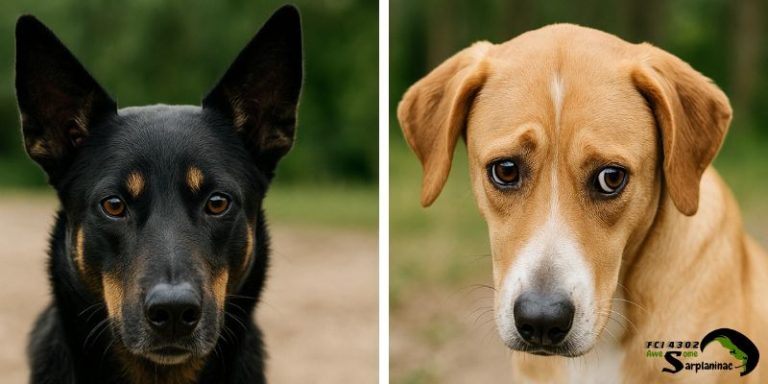


Sarplaninac or German Shepherd – depends what you actually need the dog for.
My family’s raised Sarplaninac since 1990, and my dad had a German Shepherd before that, back in 1978.
Their traits, training needs, and guarding instincts aren’t the same, and that decides which dog you should actually bring home.

Primary Purpose and Origins
Sarplaninac and German Shepherd got bred for different farm jobs – one to guard flocks alone against predators, the other to herd and drive livestock while working close with the shepherd.
Sarplaninac dogs guard livestock on their own – out with the flock, no backup. For centuries, shepherds in the Balkan mountains have used these dogs to protect flocks from wolves and bears.
Years of working rough mountain terrain made Sarplaninac hold ground and watch territory without needing anyone to tell them to.
German Shepherds are known for high trainability and staying close to their handler, taking direction fast. That’s why they end up in search and rescue, service dog, police units (or military).
While both breeds have roots in sheep-farming, the Sarplaninac stuck to one job – guarding whatever’s entrusted to it, no matter what. German Shepherd took on more jobs over time – herding, police, service …

Service as Police and Military Dogs
Both breeds serve in the military and police, but one tracks and patrols, the other stands guard.
German Shepherd’s been doing this job a long time, because it trains fast and sticks close to a handler. Countries all over use them for search and rescue, bomb detection, and tracking.
They can switch from calm tracking straight to physically restraining a suspect, without hesitating – that’s why police units rely on them so much.
Sarplaninac has heavy bone and muscle mass, plus a strong instinct to protect territory – that’s what makes them stand their ground instead of chasing. Their build and instinct to protect make them good at guarding military bases and borders.
You won’t see them on patrol much, but across the Balkans, they’re still the dog people trust for defense.

German Shepherd Linda (1978)
Linda was my father’s first dog. He got her in 1978, when he was sixteen. No internet back then, no modern training gear – just books.
He taught her over ten commands! She’d fetch the newspaper from a village three kilometers away and walk home by herself while my father kept working.
One story shows just how obedient she was. During a run-in with police, my father told Linda to jump on the roof of their patrol car and stay there.
She wouldn’t move without his word – not even when the officers, thrown off by how disciplined she was, threatened to shoot if she didn’t get down.
The situation ended peacefully, but it proved the level of control possible with the breed.
Working with Linda taught my father that discipline and patience are the foundations of training (lessons that stayed with him for life).

Sarplaninac Condor (1990)
My love for Sarplaninac dogs started with Condor. I spent part of my childhood with him. Two words for him: an amazing dog!
We bought Condor as a puppy from a breeder in Paracin, for 400 DM – the average salary in the country was 10 German marks at the time, so that was a lot of money.
My father loved a few traits about the breed most: laziness, dominance, intelligence, and independent decision-making.

Instinct and Training Differences
Sarplaninac attacks are unpredictable. You don’t need to train them for that. They target the limbs – going for the arm or the leg to neutralize a threat.
That’s why I say German Shepherd training don’t work with these dogs.
They need to look fearless and wild at first glance, but underneath that, a stable character.
Despite attempts by the army to train Sarplaninacs, the results have shown that it doesn’t work in the best way.
I suggest you watch the next video …
Conclusion
Pick the dog that fits what you need. One waits on your command, the other thinks for itself.
Internet searches show a massive gap: 2.2 million for German Shepherds versus 60,000 for Sarplaninacs.
But numbers aren’t everything!
German Shepherd is famous worldwide, while the Sarplaninac is for people who value raw strength and independence over a popular name.