
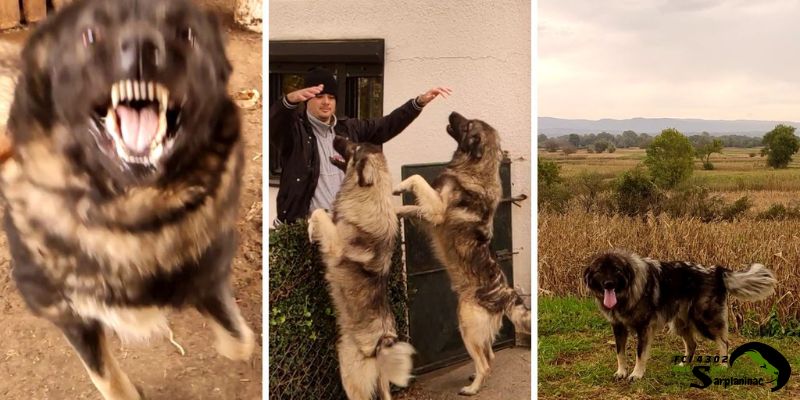

I’ve been thinking about writing an article on this topic for a long time because when you google “Sarplaninac temperament”, you mostly get copy-paste answers.
Usually, you find two or three paragraphs of text before the article moves to the next chapter. Writers and journalists on major dog websites often look at the breed through numbers and analytics, chasing a clean, short answer that ranks at the top of Google.
Whether these authors have ever seen a real Sarplaninac in person is another story (with a few exceptions).
So, where are the Sarplaninac breeders in all this? Most of it happens in Facebook groups, and no one is interested in opening Pandora’s box. Why?
After you’ve read this article to the end, you’ll understand what “stable character” actually means for a Sarplaninac, and you’ll start wondering how many owners and breeders actually have dogs like that in their yards.
That said, there are serious breeders out there who don’t seek attention, and have dogs with stable character. However, these opinions often don’t carry weight in big discussions because these people don’t have “a lot of copper” in their showcases (trophies, CAC, BOB titles).
So, later on, we’ll also talk about dog shows and how the Sarplaninac should behave in the ring.

Character vs Temperament
Here’s the difference between a dog’s character and temperament …
Character (dog’s personality):
- Character refers to the dog’s individual behavior traits, such as being friendly, aggressive, shy, or outgoing.
- It is often shaped by genetics, early socialization, and upbringing.
- Character traits are relatively stable and define how a dog behaves in various situations.
- It reflects the dog’s unique personality and how they interact with people and other animals.
Temperament:
- Temperament is the biological and instinctive part of a dog’s personality.
- It covers core traits like reactivity, fearfulness, activity level, sociability, and responsiveness to training.
- Temperament tends to show itself first in a dog’s behavior.
- It shows a dog’s innate tendencies and how they respond to external stimuli.
Character is more about the dog’s learned and individual behavior traits, while temperament relates to their inherent, biological traits.
Both character and temperament play a crucial role in understanding a dog’s behavior and how they interact with their environment and people. [1] [2]
I really like the explanation from Dr. Samuel Gosling, a social psychologist at the University of Texas, Austin.
He explains, “Temperament represents an individual’s fundamental, biologically inherited predispositions, while personality emerges as the outcome of the interplay between temperament and one’s environment.”
Gosling adds, “Since adult animals are a combination of biologically-inherited tendencies, as well as individual experiences, it seems to me misleading to call that temperament. In humans, we would call that personality, so why not in other animals? [3]
Sarplaninac Temperament
The Sarplaninac is a dominant, calm guardian – often appearing lazy because he saves energy for when it actually matters. Fiercely protective of family and property, this dog stays loyal to one master, no matter what.
Peaceful at home with those he knows, the Sarplaninac reacts fiercely the moment a stranger or predator steps onto his ground.
He never barks without a reason or attacks anyone weaker than himself. The Sarplaninac thinks for himself, deciding on his own when to react and when to hold back.
A lot of owners confirm this intelligence, often joking about forgetting to lock the front door when their dog is on duty. Even in the mountains, shepherds don’t need to stick around – Sarplaninacs watch over the flock entirely on their own.
Walking Through The City and An Unknown Person!
In the city, with an owner nearby, the Sarplaninac must stay calm. This isn’t just about the breed; it’s about socialization.
An balanced dog doesn’t care about other dogs and won’t lash out, even if they start barking first. Aware of such strength and size, the Sarplaninac simply stays above the mess.
You only see a reaction when someone crosses the ‘red line’ and the owner is in real danger.
What should you do when an unfamiliar person (even a friend) approaches? My advice is to keep talking, but stay 1 to 1.5 meters away. Keep that distance and avoid sudden movements, and that’s usually enough to avoid any issues.
Should you let people pet the Sarplaninac while you’re holding him? My answer is NO.
Let them take a photo instead.
Look at the video of Tyson playing with kids he just met right before the dog show.
There’s no secret trick to it – it’s just the result of the serious work my father put into his training.

When an Unknown Person Crosses the “Red Line”
As I’ve said, trouble usually happens when someone makes a sudden move or when a self-proclaimed ‘dog expert’ shows up. You know the type – those with high self-assurance and an “impressive CV” who claim they can approach any dog.
Let’s take, for example, what happened to us at the dog show in Jagodina. We left Krom in the car trailer with a friend nearby to keep an eye on him.
A man approached, insisting on getting close to the dog. Despite being warned several times to stay back, he brushed it off with the classic: ‘Dogs love me.’
He reached for Krom, who bit him instantly. The man ended up in the emergency room shortly after.
It is important to understand what an attack from a stable, self-assured Sarplaninac actually looks like.
The Sarplaninac doesn’t waste time – he goes straight into action. There is no hesitation when the line is crossed.
To see how this looks, watch the video below …
A Lone Sarplaninac and an Unknown Visitor – What Happens Next?
When an unfamiliar person enters a territory guarded by the Sarplaninac, especially if the dog is loose, the situation gets very serious. In this scenario, your best bet is to stay calm and, literally, stay ‘frozen in place.’
Sudden movements are the worst thing you can do. The safest move is to back away slowly and quietly, though there is a high chance the dog will already be circling you.
Shouting for help or reaching for something to defend yourself is really risky and will likely trigger an attack.
The Sarplaninac will watch your every move closely until the owner appears. If the owner is home, they’ll come out to resolve the situation. But if no one is there to call him off … you are in a very dangerous spot.

Sarplaninac vs Dominant Dogs
When a true Sarplaninac faces off against other dominant dogs, you don’t have to guess. His character is shows through pure stability:
- Ignore Provocations: A real Sarplaninac doesn’t waste time on potential opponents; he stays calm.
- No Cheap Threats: Growling or showing teeth is beneath him. He doesn’t need to “act” tough.
- Never Back Down: He never retreats or hides behind his owner.
- Dominant Posture: The tail is never tucked between the legs—it is held high and proud over the back.
- Silent Confidence: While other dominant dogs may bark and make noise, the Sarplaninac stays silent and watchful, tracking every move.
- No Warning: If the line is crossed, he attacks immediately from his position (no hesitation, no bluffing).
We even ran a test to show what undesirable behavior looks like, and how, on the breeder’s command, the Sarplaninac has to stop right away.
If you want to see a great example of a Sarplaninac’s character around other dogs, check out the video made by breeder Mladen Santic.
He took his dog to an unfamiliar place – his friend’s home, where a Central Asian Shepherd Dog lives.
This is a high-pressure situation for any dog.
The Sarplaninac handled it just as he should, showing exactly the reaction you’d want from this breed.
I recommend watching this video carefully to see what a real, balanced dog looks like in action.
Sarplaninac Character: Then and Now
Back in the 90s, my father traveled to the Shar Planina mountains to see the source of the breed for himself. He wanted to understand the real difference between the original mountain dogs and the urban Sarplaninac.
In Kosovo and Metohija, he was welcomed by serious breeders who lived with these dogs every day.
He saw many great dogs, but one encounter stuck in his memory.
If you tried to approach the dog to pet it, the old mountain breeder would tell you: ‘Please, take this dog with you. I don’t want a dog like this in my yard anymore!’
To some, this sounds harsh. But you have to understand – these men have huge properties and flocks of sheep to protect from wolves and bears. They don’t care about ‘FCI standard’.
They care about having a guardian!
Now, look at the modern show ring. You’ll see a judge pry open a Sarplaninac’s mouth to check his teeth as if they’ve been friends for years.
It makes me wonder – is an ‘unknown person’ in the ring different from an unknown person in the real world? Or have we sacrificed real character just to win trophies?

Dog Show Ring
When you enter the ring, the Sarplaninac walks on your left, moving toward the judge. After the initial questions about age and gender, the judge will move in to check the dog’s teeth.
As the owner, it’s your job to show the teeth yourself, so there’s no unnecessary contact between the judge’s hands and the dog’s jaws.
Next comes the physical exam: checking the testicles, coat length, and overall condition. This is the most sensitive moment.
What is the best way to handle this?
In my experience, the safest method is to grip the upper part of the collar with your left hand (while keeping the leash in your right). Hold the dog’s head steady so he can’t turn left or right.
This is the right way to hold a Sarplaninac that actually has the character of a true guardian. A dog like this isn’t a toy – he won’t just let a stranger pet him, and frankly, he shouldn’t.
Holding him this way keeps things safe for everyone in the ring.
Insecurity vs. Potential: The Young Dog’s Test
Of course, we have to talk about young dogs or those entering the ring for the first time. You’ll often see their tail tucked between their legs – a clear sign of insecurity. But we shouldn’t rush to judgment; caution is needed here.
In these cases, the judge should put the dog to the test.
Have the owner step back, and then, from a safe distance, the judge should make a sudden gesture toward the Sarplaninac. The young dog will either stay composed or move toward the judge to protect his space. That is the only desirable reaction.
If the dog retreats and hides behind the owner? The judge should disqualify him right then and there – and I don’t care whose dog it is or what people think.
You see this more often at specialized Sarplaninac shows than at standard CAC or CACIB events. However, in my opinion, it’s not fair to hold the young dog to the exact same criteria as a mature, experienced guardian during this test.
Once the evaluation is done and the dog gets his top grade (5), he should stay silent.
We go back to the beginning: the Sarplaninac must be above the noise, fully aware of his own strength. If the breeder wants to ‘show off’ and impress the crowd, that’s fine, but wait until the titles are awarded and the work in the ring is finished.
To see what I’m talking about, watch the video of Slavko Martinovic and his dog Barut – a breeder who’s made a real mark on this breed!
The Exception: Beyond the Guard Instinct
There’s one situation where the Sarplaninac’s sharpness takes a backseat: when the dog is needed for something more important.
I know of cases right here in Serbia where doctors advise parents of kids with health issues to get the Sarplaninac.
In these moments, the breeder’s responsibility is to recognize and hand-pick the dog with “nerves of steel” – one that is calm, patient, and won’t react impulsively to the noise and strangers that come with a difficult situation.
This is a noble mission that requires no public discussion.
The Sarplaninac has a real ability to sense a child’s vulnerability and offer silent support. It shows that, beyond the well-known protective instinct, this breed has a heart big enough to help in ways beyond just guarding.

Conclusion
I believe this gives you a clearer picture of what a true Sarplaninac character looks like. I didn’t write this to be ‘objective’ – I wrote it to be real, using the best examples to show you what this dog is meant to be.
The next time you hear someone talk about ‘purebred’ dogs, remember this: a dog’s character comes before anything else. It doesn’t matter how many titles are in the pedigree if the dog has lost its purpose.
I could have the most beautiful dog in the world, but if a stranger can walk into my home and start playing with him after two minutes without my permission, then that is not the Sarplaninac.
That is just a pet!
I will always love my dogs, regardless of their traits, but we must call things by their real names.
In the end, it’s not about how much ‘copper’ you have in your showcases. Trophies and titles mean nothing if the dog has lost the “nature” that defines the breed.
Whether facing a wolf on a mountain, staying composed in a crowded ring, or offering silent comfort to a child – the Sarplaninac must remain a guardian with a lion’s heart.
Everything else is just a show.


