


Hachiko was a white Akita Inu owned by Professor Hidesaburo Ueno. Japanese archives and photographs from that period document his life at Shibuya Station – not just the popular movies.
These sources record how the dog lived and what happened during his nine-year wait at the station.
I use historical images, books, and films to piece together the full story.
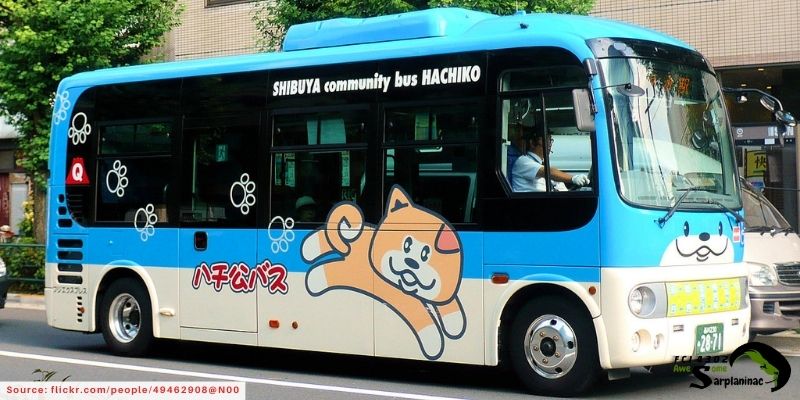
Japanese Akita Dog
Japan designates the Akita Inu as one of six national monuments. [1]
Historically, the breed hunted wild boar, deer, and the Yezo bear – a job that took real toughness.
The thick double coat sheds heavily twice a year, so grooming needs to be kept ontop of.
Akitas are good with children despite their “hunting past”, though most have a stubborn, independent side.
One thing unique to the breed is the “Akita woo” – a sound somewhere between a howl and a moan.
The most famous Japanese Akita, Hachikō, captured the hearts of people all over the world with his story of loyalty and devotion.

Agricultural Scientist Hidesaburō Ueno
Hidesaburō Ueno was born on January 19, 1872, in Hisai-shi (now Tsu), Mie Prefecture.
He graduated from Tokyo Imperial University in 1895 and specialized in agricultural engineering and farm implementation research. His academic career moved from assistant professor in 1900 to associate professor in 1902.
Ueno’s work covered arable land readjustment, drainage, and reclamation – expertise that proved vital for rebuilding Tokyo after the 1923 Great Kantō earthquake.
By 1916, as a full professor, Ueno took charge of agricultural engineering lectures and started a specialized department for the field. His career ended on May 21, 1925, when he suffered a cerebral hemorrhage during a lecture.
He is buried at Aoyama Cemetery, recognized as one of the key figures in modern Japanese agriculture. [2]
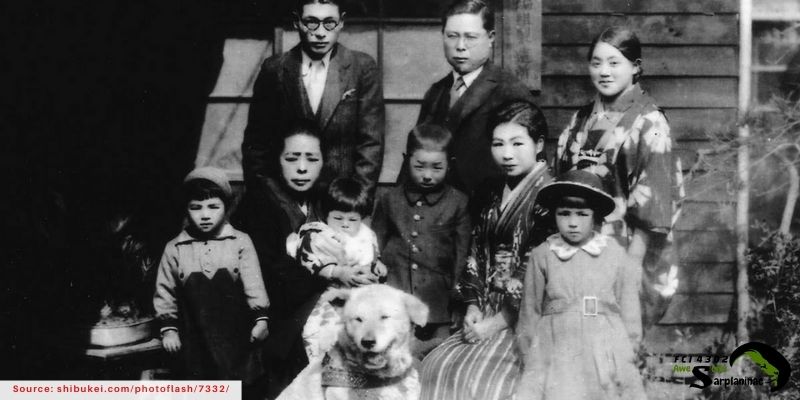
Hachiko and Professor Ueno
In 1924, Hachiko, a white Akita, came to live in Tokyo with Professor Hidesaburō Ueno. The puppy arrived weak from the long train journey and nearly died.
Professor Ueno and his partner, Yaeko, took care of him for several months until he recovered.
Every morning, Hachiko walked Ueno to the station, and every evening he came back to the plaza to meet the arriving train.
This went on until May 21, 1925. While Hachiko waited at the station, Professor Ueno suffered a cerebral hemorrhage during a lecture at Tokyo Imperial University. When the evening train arrived and Ueno didn’t appear, Hachiko kept waiting.
He kept coming back to the station day after day, waiting for his master to return.
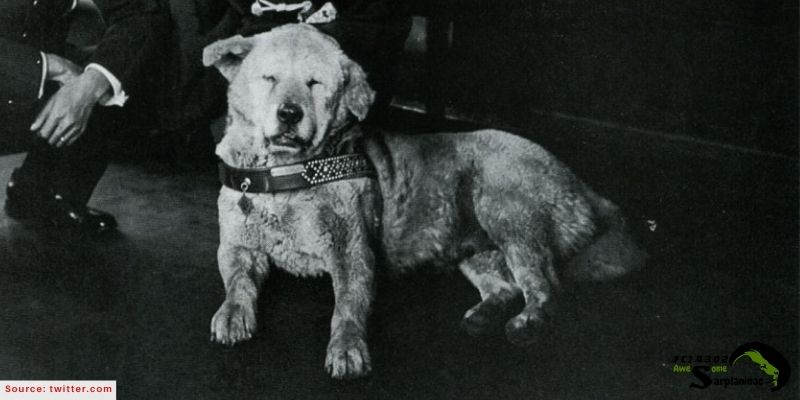
Life at the Train Station for 10 Years, 9 Months, and 15 Days
Not everyone at the station was friendly toward Hachiko at first. That changed on October 4, 1932, when a newspaper article about him came out.
Hirokichi Saito, one of Professor Ueno’s former students, spotted Hachiko at the station and followed him to the home of Ueno’s former gardener.
Saito wrote a few articles about Hachiko’s loyalty, and in 1932, one of them ran in the Asahi Shimbun and caught the attention of the whole country.
The headline read: “Tale of a Poor Old Dog: Patiently Waiting for Seven Years for the Dead Owner.”
After that, people brought him food and treats and even organized to cover his vet costs. Hachiko had made many friends at the station who were touched by his story. [3]
The Final Goodbye
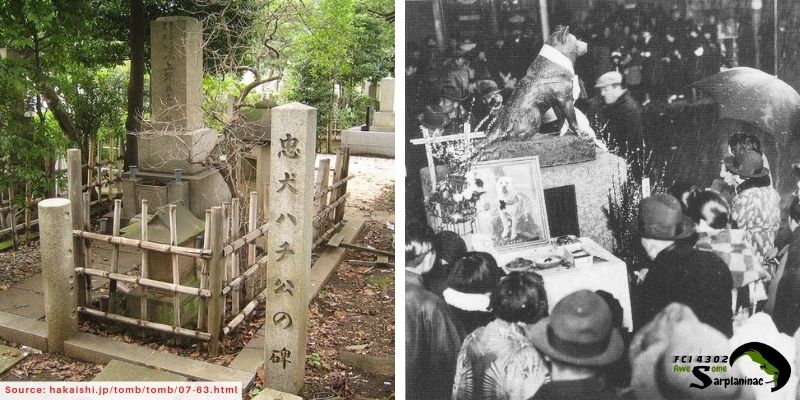
In April 1934, a bronze statue of Hachiko, sculpted by Teru Ando, was put up at Shibuya Station.
Hachiko was there for the unveiling.
The original statue was melted down for scrap metal during World War II. A replacement was made in 1948 by Takeshi Ando, the son of the original sculptor.
Hachiko’s ten-year wait ended on March 8, 1935, when he was found dead on a street near Shibuya Station at the age of 11.
Scientists confirmed in March 2011 that he died from terminal cancer and a filariasis infection.
Hachiko’s ashes were placed in Aoyama Cemetery, right beside the grave of Professor Ueno. His fur was preserved and taxidermied and remains on display at the National Museum of Nature and Science in Ueno, Tokyo. [4]
Cultural Impact and Global Legacy
Hachiko’s story went from a Japanese national symbol to a global one through film and media.
The first major film was the 1987 Japanese movie Hachikō Monogatari, followed by the 2009 Hollywood remake Hachi: A Dog’s Tale, starring Richard Gere.
Hachiko is now a permanent part of Tokyo’s identity.
The “Hachikō-guchi” entrance at Shibuya Station is one of the city’s most well-known meeting points, and his story is still used in Japanese schools to teach children about loyalty and perseverance.
Famous Books
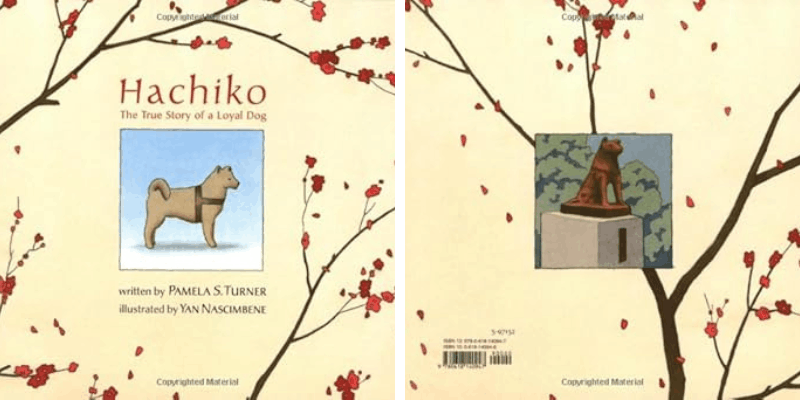
The most well-known book on the subject is Hachiko: The True Story of a Loyal Dog by Pamela S. Turner.
The story follows a fictional young boy named Kentaro and his interactions with the Akita, which makes the ten-year wait easier for younger readers to connect with. Turner keeps it grounded (no over-dramatizing, just the quiet reality of the dog’s daily life).
The illustrations draw from traditional Japanese woodblock prints and bring the Shōwa era to life, showing the contrast between traditional kimonos and the Western influence creeping into 1920s Tokyo.
In her author’s note, Turner says her inspiration came from living in Tokyo and seeing the bronze statue at Shibuya Station.
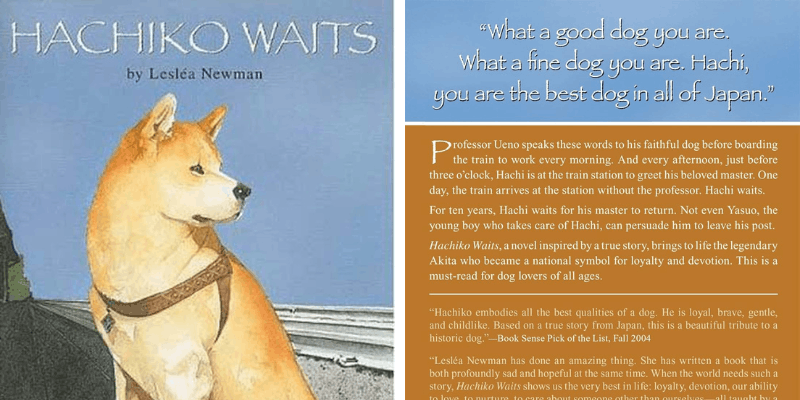
“Hachiko Waits” by Lesléa Newman (2004)
Awarded Best Children’s Book of the Year by Bank Street, this novel takes a more emotional approach to the story.
The narrative follows the relationship between Hachiko and a young boy named Yasuo, who becomes his caretaker after the Professor’s death.
Critics call it “profoundly sad,” but the book never loses sight of the bond between humans and animals.
The illustrations by Machiyo Kodaira, a Tokyo native, are praised for being “authentically Japanese”.
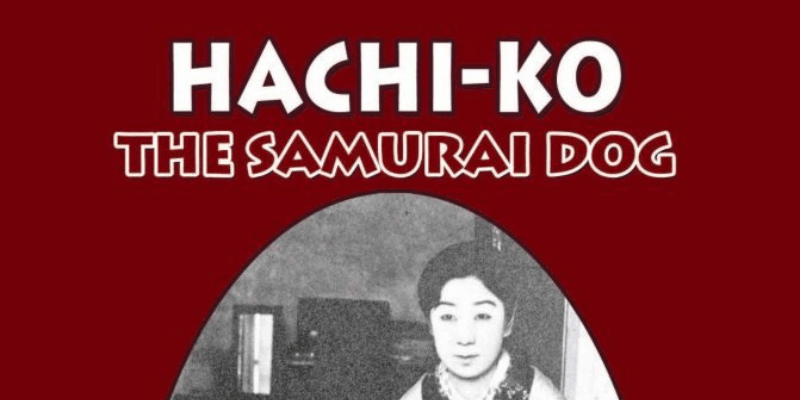
“Hachi-Ko: The Samurai Dog” by Shizuko O. Koster
This book brings to life the story of Tokyo’s “four-legged hero” during the turbulent 1930s.
Shizuko O. Koster draws on stories from her mother’s generation to show the reality of Hachi-Ko’s life: while he was honored with a statue and celebrated by thousands, he was living as a street dog in a drainpipe.
Once the cherished pet of Professor Eizaburo Ueno, Hachi-Ko became a national symbol for his loyalty.
For seven years, he came back to Shibuya Station every single day, fighting off delinquents, dogcatchers, and vicious strays.
He’s still known today as the “samurai dog of Japan” – a devotion that never faded.
Famous Movies
Hachiko Monogatari (1987) – This Japanese film is based on Hachiko’s life and stars Tatsuya Nakadai as Professor Ueno.
The most well-known film about Hachiko is the 2009 American movie “Hachi: A Dog’s Tale.”
Starring Richard Gere, it follows Hachiko’s life and his bond with Professor Ueno.
A favorite among dog lovers worldwide!
Conclusion
Hachiko’s story shows what loyalty and love dogs are capable of. Over the years, it’s touched people all over the world and inspired books, films, and other media.
I’ve collected a lot of information on this topic, going through books and films that each show a different side of Hachiko’s life.
That research even led me to write a movie script about the Sarplaninac dog, another breed known for courage and devotion.
From the loyalty toward Professor Ueno to the friendships formed at the station, the story still moves people today.
Sources:
- Clever, Obedient, and Cute! The Charm of Japanese Dogs Like Shiba-Inu and Akita (more information).
- Hidesaburō Ueno (more information).
- Thangham, Chris V. (August 17, 2007). “Dog faithfully awaits return of his master for past 11 years”. Digital Journal.
- Ovako je izgledao pravi Hačiko, verni pas koji je 9 godina na stanici čekao pokojnog vlasnika (more information).



Tell me, is there a more detailed description of the life of Hachiko and Professor Ueno? How did they live before the tragedy? What was their relationship like? How much did Ueno love Hachiko?
Hi Svetlana,
Thank you for your comment! I’m glad to see your interest in the story of Hachiko and Professor Ueno. The article covers the main aspects of their story, but there’s definitely more depth to their lives and relationship.
For a more detailed account of their lives before the tragedy, including how they lived and the nature of their bond, you might want to explore additional sources such as books or documentaries about Hachiko.
I appreciate your feedback and will consider including more details in future updates to the article.
Alen Stefanovic