
Most puppies can walk up stairs by three months, but their weight and the fact that their bones are still forming decide when it is actually safe.
The big question is whether those young joints can take all that weight without getting hurt.
Using stairs too early causes hip dysplasia, leaving dogs with bad joints for the rest of their lives.
Breeding Sarplaninacs for over 30 years has taught us what that weight does to joints that are still forming.
Is the Puppy Ready for Stairs?
From the day you bring the puppy home at around eight or ten weeks old, he might try to climb a step or two.
However, that doesn’t mean he should use them.
At this age, a step is just something to “sniff around”, not for climbing.
You just want the puppy to take one step calmly under your control (without any jumping or slipping).
Do Stairs Harm Your Dog’s Joints?
Let me share the information I found on the internet while preparing for this article.
“Yes, stairs are bad for dogs with arthritis. This is because stairs may strain the areas of the body that suffer pain during movement – mainly the joints of the limbs. Stairs are also a potential accident hazard – one that is more real because the motions of the arthritic dog are not adequately controlled”. [1]
“In fact, walking UP stairs can be a great way to help improve active range of motion, muscle strength, and proprioception (the awareness of the position and movement of the body). Navigating stairs daily have helped Dr. Kirkby Shaw’s dogs with arthritis maintain their mobility!”. [2]
This shows why you should always check multiple sources before making any big decisions.

What Vets Say About the Risk?
Q: Recently I heard that the dog until a year of age shouldn’t walk on stairs, and I have the dog around month and a half old is 3 months. Now he has 10 kg and from the first day he went on stairs both up and down. Now it interests me how much it is dangerous and is it necessary to carry him on them? He passes around 30 high steps at least 10 times daily. How much temporally should last the walk of such a young dog? In the morning he is usually in a half-hour walk, over the day he has access into the yard so even there he goes crazy and towards evening we go out for an hour or longer. If he over-tires on the meadow, and it needs yet to come to home, then he is carried, although that is very rare because he loves to be outside. How to then I know which limit of walking he may have? Thanks.
A: Much of movement (exercising) and proper diet make the basic elements of good health of the puppy. Healthy puppies are lively, full of energy, and to them is needed much of movement and exercise. The quantity of needed exercising especially doesn’t depend on the size of the dog but most of all on its breed. Hunting dogs, for example, like pointers or retrievers, once upon a time were bred and prepared for all-day stay on the terrain. Such dogs are not happy and of good health without much of movement and exercise.
With regard to how you didn’t state about which breed it is, and in the age of 3 months he has 10 kg, of the opinion I am how as an adult dog he will have up to 25 kg, and as such classifies into medium large dogs. A characteristic is only of large and gigantic breeds of dogs the sensitivity to the bony and system of joints with regard to the weight of the body which must this system support. The young dog of medium breeds of dogs grows until the age of around 12 months, and through all that time intensive is the growth and building of bones. To proper development favors quality nutrition, enough movement, stay on the open, and appropriate body weight. Physical activity is extremely important for the development of the organism of the young dog, but certainly it is necessary to mention that it needs to be moderate while lasts the development of the bony and muscular system.
To puppies in development needed is much of rest, attention, and exercising. Certainly it is necessary to lead account to afford to the puppy rest on the first signs of fatigue. If that encompasses also the carrying of the puppy on the way to home, afford to him that. For proper growth and development of the bony system until the 5th month of age it is recommended that the puppy shouldn’t walk on stairs. How much ever you are in the possibility, carry him. With regard to the daily activities of the puppy, truly to him you afford optimal ones. An ideal indicator of good condition of the puppy is walking 20-30 minutes without tiring.
In the growth and development of the puppy very much is important to ensure also a quality and balanced nutrition. The quantity needed for satisfying the daily need for nutritive matters of the puppy are individual, and depend on age, size, the breed, and physical activity. Feeding him with highly quality food rich with proteins from meat, you will ensure to him a sufficient quantity of proteins and other nutritive ingredients, needed for his growth and development. For the skeleton in development needed are also vitamins and minerals, and especially calcium and phosphorus, and vitamin D, therefore in that time indispensable is a sufficient and correct supply of the organism with those matters.
The causes of diseases of joints generally can be trauma, infection, hereditary tendency to accumulating of excess weight, and in some cases also excessive physical activity. But, in the majority of cases it is about older dogs to whom in different degree are diagnosed degenerative changes of joints. [3]
Zdravka Rumiha, DVM,
Pet Center Drvinje 1, Zagreb
Let’s Talk About Sarplaninac Puppies!
I’d like to go back to the beginning of this article and look at four important things: breed, anatomy, weight, and temperament.
The Sarplaninac is a robust, heavy-boned dog of impressive size. Its thick, coarse coat further highlights its compact, powerful build.
In recent years, people talk a lot about hip dysplasia in this breed.
While I don’t deny these claims, you must see the difference between genetics and “lazy” owners or breeders.
Many dogs used as examples by “experts” on websites, videos, and books are not even Sarplaninacs, proving they don’t know this breed.
Back to the puppies …
Anatomy is everything, and a Sarplaninac puppy and a Dachshund puppy can’t be compared when it comes to stairs and joints.
The Sarplaninac puppy’s pasterns show clearly if he is carrying too much weight.
This puppy already carries enough “burden on their back” and going up and down stairs would be a challenge.
It would be like a noose around their neck.
Puppies like these are really cute (like little bears), but in most cases, their temperament is questionable. They don’t care about anything around them, hiding behind laziness with a sad look.
I am talking about Sarplaninac puppies aged 3-5 months and we must not generalize things!
Plus, because of that extra weight, they can’t even walk a normal distance for their age.
My advice is a balanced diet and rest, along with some time in the sun to get vitamin D for healthy bones.
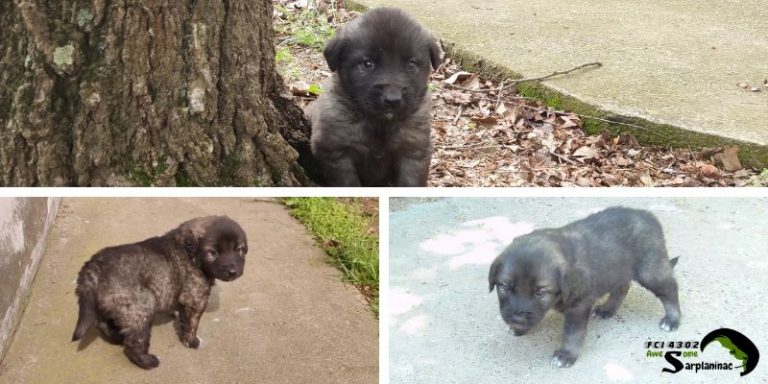
Unlike them, there are Sarplaninac puppies who are extremely fast, agile, and interested in their surroundings.
Their tails are always up and wagging when there’s an alert.
At three months old, they might look lean, or even starved to amateurs, but they are growing just fine.
You can see they are full of energy, so moderate activity is good for them.
However, it doesn’t mean the puppy can go up and down the stairs 24/7. – No!
Training is the key, and it requires experience or advice from real breeders (including proper nutrition, exercise duration, etc.).
The Facebook Post That Started It All
I recently shared a video in a Facebook group focused on Sarplaninac dogs.
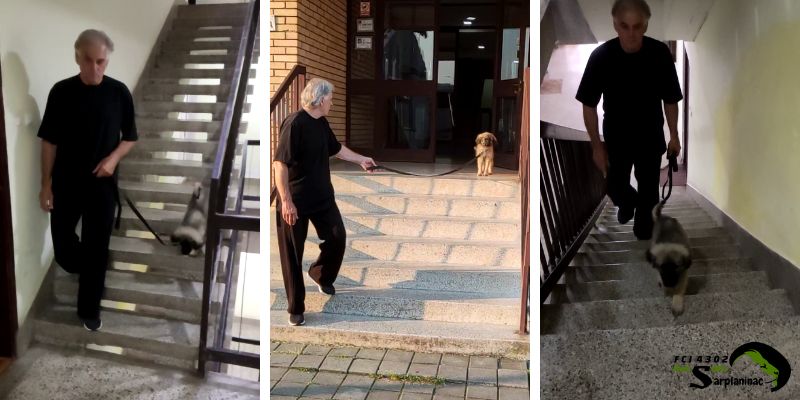
In the video, you can see my puppy going up and down the stairs with no fear, both on and off the leash.
Although I didn’t mention the puppy’s age or gender, the whole point was to show socialization.
Watch the video below to see how my puppy does it.
I knew some people would leave negative comments, mostly because of the building, the puppy’s young age, the stairs, and what they do to joints.
Everyone who wanted to give me “advice” did the exact same thing:
- Nobody asked how old the puppy is.
- Nobody said anything nice before they started judging.
- Nobody noticed that we chose this puppy, not another one from the litter because it has one element that the others don’t.
- None of them cared about our knowledge and experience.
- Most of them think the puppy goes like this every day at least xx times up and down 24/7.
Be careful when posting videos like this in Facebook groups! You need strong arguments for discussion.

What Are the Real Symptoms of Hip Dysplasia?
Symptoms of hip dysplasia in dogs include:
- Less activity (the puppy becomes unusually “lazy”).
- Stiffness or less movement in the back legs.
- Struggling to stand up, run, or climb.
- Limping or stiff back legs.
- The “bunny hop,” using both back legs together to move.
- Clicking sounds in the joint when moving.
- Losing muscle in the thighs (thinner back legs compared to the front).

Parents of Puppies Have Excellent Elbows and Hips (HD-A and ED-0)
That’s good, but it can be even better if you have information about the hip and elbow health of the puppy’s parents and ancestors going back 6-7 generations.
By having this “genetic background”, it means that the homework has been done in the right way.
However, it is clear that the problem can indeed come from things like stairs and too much exercise.
Conclusion
I wanted to put the veterinary facts alongside the reality of raising a Sarplaninac, because this breed doesn’t fit into a “one-size-fits-all” box.
Talking in general is easy, but it is often wrong.
When it comes to your puppy and the stairs, don’t just follow a rule. Look at the dog in front of you and pay attention to his weight, anatomy, and how he actually moves.
Wishing you all the best, and thank you for your attention.
Sources:
- Why Using the Stairs is a Challenge for Dogs with Arthritis (HandicappedPets.Com);
- Is it ok for my dog to use the stairs at home? (more information);
- Stepenice i šetnja (more information).