
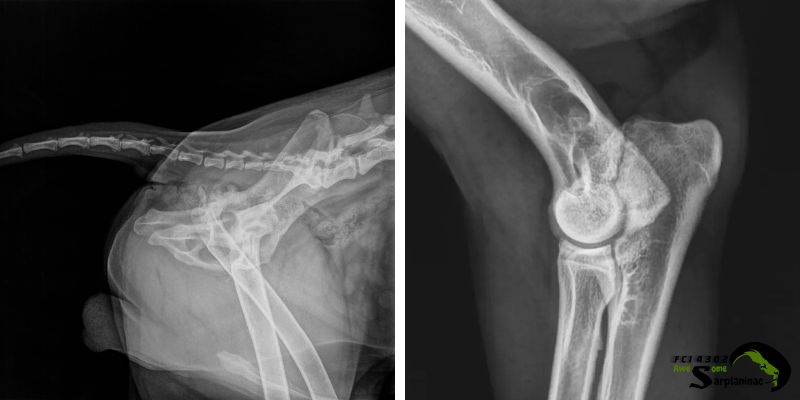

We get this question a lot – from visitors on our website and social channels to people thinking about getting a Šarplaninac.
It’s an important, sensitive topic, and we’ll get into the science, how it’s diagnosed, and what genetics actually has to do with it.
Before we begin: I am not a veterinarian!
Treat this as a breeder’s perspective, not medical advice. Always talk to your vet, look into it yourself, and make up your own mind.

What Is Hip Dysplasia in Dogs?
Imagine your dog’s hip joint as a ball fitting into a socket. With hip dysplasia, that ball doesn’t sit snugly, it rattles around. It’s like trying to drive a car with wobbly wheels (everything wears out faster).
This looseness causes grinding, pain, and wear over time, leading to arthritis. It’s not an infection or injury; it’s a mismatch in growth between bones and soft tissues as your puppy develops.
Why Does It Happen?
Genetics: Some breeds inherit higher risk.
Growth speed matters: Puppies who grow too fast or carry excess weight strain their developing joints.
Activity impacts it: Slippery floors or high-impact jumping (like fetching frisbees) can worsen weak hips.
Bigger dogs often face this because their joints grow faster than their bodies can support. But any dog can develop it – purebred or mutt, young or old.
I see two closely linked words as the key to this: genetics and rapid growth. Why? Because together, they prove hip dysplasia develops over time – it’s not present at birth.
And since many genes are involved (polygenic inheritance), that raises another question …
Inbreeding and Hip Dysplasia?
I found an interesting study – analyzed pedigrees of 41,728 dogs across 9 breeds and examined hip dysplasia (HD) in 1,745 dogs.
Surprisingly, it found breeds with higher levels of inbreeding actually had lower rates of hip dysplasia. Breeds where a single ancestor heavily influenced the gene pool also showed less HD.
The research suggests keeping inbreeding below 3.25% (roughly equivalent to cousins mating) is safe for hip health, as long as breeders carefully select dogs with good hips.
But the study stresses that all breeding dogs still need hip screening – inbreeding alone doesn’t guarantee healthy joints, and HD is still a complex condition that has to be judged case by case. [1]

Can Dogs With Excellent Hip Scores Produce Dysplastic Offspring?
You’ll often see breeders advertising puppies on social media, showcasing the parents’ certifications: “HD-A & ED-0” – proof of excellent hips and elbows.
The comments flood in: “A serious breeder! Well done! …”
But what actually impresses me? Breeders who provide 5-6 generations of health records – both sire and dam lines.
That says a lot: “I’ve done everything possible to prioritize health“.
You have my respect!
Yet I’ve always wondered: Can dogs with perfect scores still produce puppies with poor hips or elbows?
Let’s see what science says …
Founded in 1966 to deal with these conditions, the Orthopedic Foundation for Animals (OFA) has helped move things forward – yet 50 years of selective breeding and research still haven’t removed them from the top threats to canine welfare.
Some breeds show improvement, but the battle is far from won. This puts breeders in a tough spot:
- Dogs with excellent hips can produce dysplastic puppies.
- Dogs with fair hips might still produce healthy offspring.
Do we cull all breeding candidates with imperfect scores? What if the breed already suffers from dangerous genetic bottlenecks and multiple health crises?
Is pairing a dog with “fair” hips to one with “excellent” scores an acceptable risk? Should a dog with one bad hip be bred? Or one from a litter where siblings had perfect hips?
OFA data (Keller 2012) gives us actual numbers:
- Breeding two “excellent”-rated dogs still produces 3.6% dysplastic offspring.
- Pairing two “mildly” affected dogs produces ~70% acceptable hips—but incomplete data submission likely paints an overly optimistic picture. [2]
There are no easy answers!
 Pin
Pin Fries and Remedios (1995)
When it comes to hereditary risks in breeding programs, the 1995 study by Dr. Fries and Dr. Remedios is still one of the most important. Their work exposed a harsh truth:
- Even when both parents have radiographically normal hips, 37,5% of their offspring could still develop canine hip dysplasia (CHD).
- The risk escalated to 52% if one parent was dysplastic and a staggering 85% if both parents were affected. [3]
What this tells us is that reducing CHD takes more than checking the parents’ hip scores – it needs genetic screening across multiple generations.
To conclude this section, I’d like to share some data I came across from Rosenberg Chiropractic Clinic’s research on canine health …
Breeding outcomes for hip dysplasia (HD):
- Two parents with good hips: 10% risk in offspring.
- Good × fair hips: 15% risk.
- Two parents with fair hips: 20% risk.
- Two parents with HD: 36% risk. [4]
These numbers look a bit more optimistic than what the 1995 research found.
The Genetics vs. Environment Factors?
Before I answer this, there’s something important to point out about hip dysplasia.
While research has not yet identified every genetic factor involved, we do know that multiple genes contribute to abnormal joint development.
Many dog owners automatically assume dysplasia is purely genetic – blaming either the breeder or bad bloodlines. But this leaves something out: environmental factors matter just as much.
Using various sources (literature, publicly available study reports), I’ve found genetics typically account for 15-40% of dysplasia risk, while environmental factors like improper nutrition, excessive exercise during growth periods, and weight management make up the remaining 60-85%.
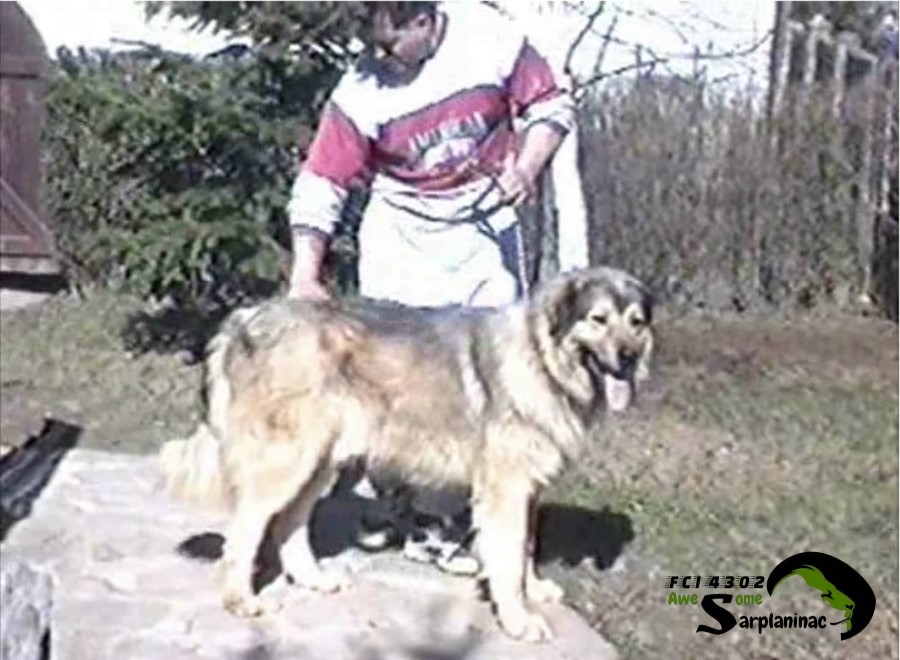
What is Elbow Dysplasia in Dogs?
Elbow dysplasia is another problem that comes up a lot in dog breeding. Like hip dysplasia (HD), it is classified as a group of developmental diseases. It’s a complex disease caused by osteochondrosis – a defect in cartilage ossification during bone growth.
Elbow dysplasia is a collective name for 3 different pathological conditions: Fragmented Coronoid Process (FCP), Ununited Anconeal Process (UAP), and Osteochondrosis of the Humeral Head (OCD). The joint surfaces often end up uneven because of it.
One or both elbows can be affected, in both males and females. In some breeds, it shows up more often in males.
Elbow dysplasia can be noticed as early as 4-6 months of age. All three elbow disorders (FCP, UAP, OCD) can be treated surgically, which is likely why this defect hasn’t been studied genetically as much as HD. Genetically, ED is considered a disease caused by multiple genes, called polygenic inheritance.
The genetic control of this defect is still not entirely clear.
Structure
Elbows have a complex structure, and any change in the normal configuration leads to pain and limited use of the limb.
Elbow dysplasia is a pathological condition affecting one or more areas of the elbow joint.
In many cases, osteochondrosis of the humeral head and the coronoid process (FCP) show up together. Ununited anconeal process (UAP) usually occurs alone.
The simultaneous presence of all three pathological conditions is rare. [5]

Do Our Dogs Have Hip and Elbow X-Rays?
I’m cautious about mandatory X-rays – taking a perfectly healthy dog to the vet where it’ll likely need anesthesia just to get its elbows and hips scanned.
You have to decide if it’s worth sedating the dog just to get the scan. To some, these certificates are the only label of a “responsible breeder,” but no piece of paper can substitute for a dog’s natural strength, stability, and ability to move freely.
If you’ve read the article above, you already know these scans aren’t a guarantee – they reduce the odds, but they do not eliminate the risk. And let’s not forget: genetics are only one piece of the puzzle.
Environmental factors, as I mentioned, play just as big a role in whether a dog actually develops symptoms.
Who is a responsible breeder?
The responsible breeder pays attention to every puppy in the litter and makes selections – not every dog can be top quality.
They focus on proper nutrition, balanced exercise, and working with their dogs (nearly) every day.
For breeders like this, health certifications and show trophies aren’t the priority – what matters most is the dog’s core character (which matters more than ever for the Sarplaninac breed).
The goal is balanced dogs: neither aggressive nor timid.
When problems come up, they work closely with owners to sort them out, offering advice that comes from years of hands-on experience – knowledge you won’t find in books or online articles.
They protect the breed’s integrity, both at home and abroad, so its qualities carry on for generations.
Conclusion
Do not rush to judge a breeder’s work or dismiss them as irresponsible simply because their dogs lack the specific certifications you care about.
If your main concerns when buying a puppy are hip/elbow x-rays of the parents, big show titles, or extensive health testing, that’s completely valid.
But allow me to conclude with this …
I’d much rather keep a true Šarplaninac – one with unwavering character and stability, even if its joints and hips aren’t perfect – than own a dog crossed with other breeds (Shar-Caucasian, Shar-Bernhardiner, etc.) that somehow becomes the “gold standard” of quality just because it won at major international dog shows and, above all, has flawless hip and elbow scores.
A dog’s worth is measured in more than ribbons and radiographs …
Sources:
The Relation between Canine Hip Dysplasia, Genetic Diversity and Inbreeding by Breed – more information
Citizen Scientists: Let’s do something about hip dysplasia! – more information
- Canine hip dysplasia: Pathogenesis, phenotypic scoring, and genetics (PDF) – more information
- What is Hip Dysplasia – more information
Displazija zgloba lakta (DZL) kod pasa – more information


