

When your puppy won’t stop biting, it’s hard to enjoy anything.
Those sharp teeth leave marks all over your hands, and there are times when you probably regret bringing a dog home.
I know what it’s like when every time you reach out to play, you end up getting bitten.
Instead of just hoping the biting stops on its own, you need to set the rules.
Here is how to stop the nipping so you can finally sit on the couch and relax without having to hide your hands.
Why is the Puppy Actually Biting
It’s easy to think those sharp teeth on your skin mean aggression, but that is almost never the case.
Here is why you are becoming a target:
- Lack of socialization: If puppies don’t spend enough time around people, animals and different environments, fear takes over. When they feel anxious or cornered, biting becomes the only way for a young dog to defend himself.
- The teething struggle: From 12 weeks to 6 months, gums are sore and itchy. Your puppy isn’t trying to cause pain. He is just looking for anything to chew on to soothe his gums, and your hands are right there.
- Play that goes too far: Without rules, a simple game quickly turns into what looks like an “attack”.
- Genetics and breed instincts: You cannot ignore what the dog was bred to do. A livestock guardian breed is born with an instinct to watch, bark, and drive threats away.
You have to show the puppy that your skin and clothes are not toys, and as soon as those teeth touch you, the fun ends.

How to Stop the Nipping
Don’t waste time on “soft” methods. You just want the biting to stop. The logic is simple: the puppy needs to learn that your skin is the end of all fun.
Here is what you need to do:
- Stand Still: This is the most important part. When you pull your hand away or move your legs, you trigger the chase. If you stand still, he loses interest.
- No Sounds: Forget about yelling when he bites because it just gets the puppy more excited.
- Attention: The puppy just wants your attention. Turn your back when he bites your skin or clothes. If he won’t let go, leave the room.
- The 30-Second Break: Give him a short time-out. Leave the puppy alone until he calms down, and start playing again when he is quiet.
You can also place him in his crate. [1]

Give the Puppy Something Else to Bite
Do not just tell the puppy what not to do. Give those jaws a toy and buy something he can bite.
When the puppy tries to grab your skin or clothes, put a tough toy in his mouth. Choosing the toy lets the fun continue, but biting you ends the game.
Tiny toys made for small dogs can be swallowed easily and will not last a minute against a strong breed.
You need sturdy tug ropes or hard rubber toys.
The toy lying on the floor is useless. You have to make it move so the puppy wants to chase it. Drag a rope or wiggle the toy on the ground so he goes for that instead of your ankles.
Teething between 3 and 6 months makes his gums sore, and he needs to chew to get through it.
Do not give the puppy a toy right after he bites, or he will think it is a reward. First, make him sit or lie down, and give him the toy only when he calms down. [2]

Reward the Good Stuff
Do not just say no to the puppy. Reward him for doing the right thing.
Use treats or praise to reward the puppy every time he grabs the toy instead of your hand.
If the dog is calm or playing with the right object, make sure he knows that is what gets him the treat.
Rewards show the dog what pays off.
When the puppy sees that biting the toy gets him the treat or a game, he will go for that to get what he wants.
This makes the rules clear so the dog keeps paying attention to you.

Tired Puppies Don’t Bite
Take the puppy for a short walk to burn off energy (not just sniff around).
Play fetch or tug-of-war to tire the puppy out. These games give him a job so he doesn’t start looking for things to destroy.
You can also start basic obedience or agility training to make the dog work for the treat.
Puzzle toys filled with food are great for holding the puppy’s attention when you cannot play.

Dealing with Sarplaninac Puppy Biting
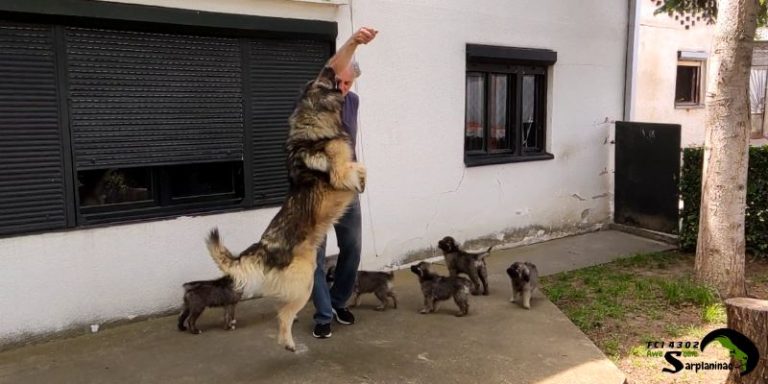
I enjoy playing with my Sarplaninac puppies, but I set the rules of the game. At 2 months old, they look like teddy bears, but they still need to learn.
When the puppy tries to bite my hand or leg, I end the game right away.
A firm “No” is enough, and if that doesn’t work, I ignore the puppy until he calms down.
We use the same approach during feeding.
To see this in practice, watch this video where my father does serious training with a tough puppy from our kennel.
Conclusion
You don’t need to be too harsh, but the dog must know you are in charge.
When the puppy is over 7 months old and still bites, you’re dealing with dominance.
Find a dog trainer if you cannot solve the problem alone.
Sources:
- Agresija šteneta prema vlasniku i ukućanima (more information);
- Kako sprečiti štene da grize: 7 dokazanih trikova (more information);