


Deep in the Šar Mountains, on the border between southern Serbia and Northern Macedonia, one dog breed has been guarding flocks for centuries.
The Šarplaninac (pronounced shar-pla-nee-natz), also known as “Sarplaninac” or “Šarac,” is a mountain dog with a history that goes back as far as the mountains it came from.

Origin
Nobody knows for certain where the Sarplaninac actually came from.
Some say it descends from wolves, others point to the Black Tibetan Mastiff. But based on my own research and the literature I’ve gone through, the most likely ancestor is the Molossian dog.
The Molossian goes back to Epirus, around 1200 BC.
These dogs guarded sheep and goat flocks, protected settlements from attackers, and got sent into actual battlefields against enemy troops. [1]
When people migrated from the East into the Balkans, they brought these dogs along. By the fourth century BC, during Alexander the Great’s reign (336–323 BC), they were already being used in battle against his enemies.

Russian sources say the Caucasian Shepherd goes back to the same Molossian roots.
One thing both breeds share that most people don’t know – neither the Sarplaninac nor the Caucasian Shepherd can have a solid black coat – but the two breeds are pretty different beyond that.
The First Dog Show 1926
Author: Dipl. Eng. Boris Špoljarić
Cynological Judge
At the First International Dog Show in Ljubljana, held on September 8 and 9, 1926, a group of dogs known as “kraški ovčari” (as mentioned in the catalog) participated.
Two males were exhibited, namely Mrko and Turko.
Here are the details: Mrko (JRSp 29 IO-1, sire Marko, dam Pikola, born on May 15, 1924, bred by Pavle Vodopivec from the village of Petelinje near St. Peter on Kras (today’s Pivka), owned by the “Golovec” kennel (Ivan Pestotnik) from Ljubljana, receiving a grade of very good.
As for Turko, the information is as follows: (JRSp 30 IO-2, sire Tabor, dam Griva, born at an unknown time; bred by Ivan Pozar from the village of Volcje near St. Peter on Kras, Pivka, owned by Branko Bezjak from Ljubljana, receiving a grade of excellent.
Due to the needs of the royal army, dogs were brought from the Šar Mountain in 1928, as evidenced by a photograph taken somewhere at the foot of this mountain.
The picture includes 9 individuals: Captain Kasidij (the third person from the right), a military veterinarian (the sixth from the right), the veterinarian’s wife (next to the captain), while the others are Albanians from Bitola, along with 10 Sarplaninac dogs (Zov, 273/1994; B. Špoljarić, 2012/2013).

“Mirna” Dog Kennel
The Yugoslav Canine Club joined the FCI on May 10, 1929, officially introducing the Illyrian Shepherd breed (R. Orban, 1958).
Franjo Bulc (1901-1979) was a veterinary doctor in Tetovo and Gostivar from 1925 to 1930. He joined the Club of Sports Dog Enthusiasts in Ljubljana in 1924 and started breeding Illyrian Shepherds out of the “Mirna” kennel.
He picked dogs straight from the Šar Mountains and brought them back to Mirna in Dolenjska, where he lived.
At the Second International Dog Show in Ljubljana on May 19-20, 1929, seven Karst Shepherds were registered.
Five dogs were judged at the show, plus two not listed in the catalog. One of them was the male Karamashi I (JRSp 58 IO-10, unknown parents, born November 15, 1926, Šar Mountain, unknown breeder, “Golovec” kennel), who scored Very Good (A. Šuster, 1938).
In September 1929, four Karst Shepherds competed at a dog show in Vienna. The male Sar (JRSp 57 IO-9, unknown parents, born June 15, 1928, Šar Mountain, Franjo Bulc’s “Mirna” kennel) scored Excellent and took the Vienna Champion title (A. Šuster, 1938).
It was the first time Illyrian Shepherds were shown outside the Kingdom of Yugoslavia.
The first international and Yugoslav champion was the male Dečko Mirnski (JRSp 158 IO-22, sire: Karamashi JRSp 59 IO-11, dam: Cura JRSp 65 IO-13, born April 3, 1932, bred by Franjo Bulc’s “Mirna” kennel, owned by Steve Sinko’s “Osoje” kennel from Škofje Loka).

His sire was Karamashi II (JRSp 59 IO-11, unknown parents, born April 10, 1927, Šar Mountain, “Mirna” kennel), and his dam was Cura (JRSp 65 IO-13, unknown parents, born May 2, 1929, Šar Mountain, “Mirna” kennel), as mentioned by A. Šuster (1938).
Based on that, this was the Sarplaninac raised in the Drava Banovina.

Preparing for the Standard
For the Illyrian Shepherd to get international recognition, a breed standard had to be written.
On March 19, 1936, the Club of Sports Dog Enthusiasts (KLSp) sent out invitations for the First Meeting of Illyrian Shepherds.
The event was held on April 5, 1936, in the pavilion of the Dolničar restaurant at the Ljubljana Fair.
The plan was to use the data collected that day would be used to write an official FCI standard for the breed.
The judging panel consisted of Dr. Ivan Lovrenčić (1878-1952), with Dr. Josip Ceruder and Teodor Drenig (1890-1977) as judges.
Thirty dogs were shown – 17 males and 13 females.
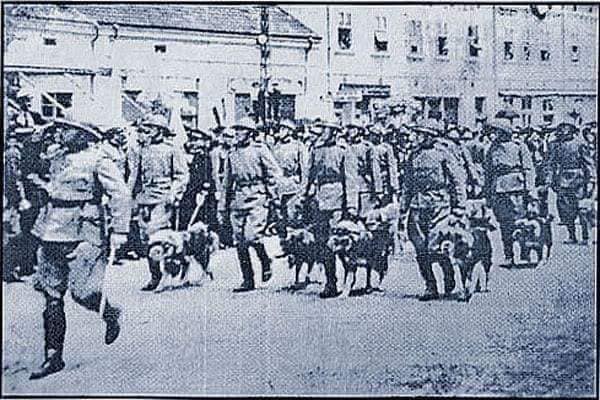
The “Kinološki Glasnik” (1937), the magazine of the Canine Club in Belgrade, ran a photo of the “Šarplaninski ovčarski pas” (Sarplaninac) serving in the army, taken at a military parade in Niš.
The exact date of the parade isn’t known, but it was likely sometime in 1936-1937.
The photo shows a group of soldiers alongside Sarplaninac dogs used in military service. [2]
The Illyrian Shepherd (1937 – 1957)
The FCI recognized the breed in 1939 as breed number 41 under the name “Illirski Ovcar” – the Illyrian Shepherd Dog.
The name came from the region itself, which was once known as Big Illyria.
At the time, the breed had two distinct types: Type A from the Šar Mountains and Type B from the Karst Plateaus.
The Yugoslavian Federation of Cynology didn’t want two types under one breed name and pushed to register them as two separate breeds.
In 1957 the Sarplaninac got a new official name – the “Yugoslavian Shepherd Dog Sharplanina” – and in 1968 the Karst Shepherd was registered as its own breed.
Sarplaninacs were also official working dogs in the Yugoslav People’s Army.
Military training centers for dogs and handlers did a lot to keep the breed alive, well-known, and true to type during that period. [3]

FCI Standard N 41 (1970)
The Sarplaninac standard was written by Prof. Dr. Slobodan Pavlović (1912-1994), the dean of Serbian and world cynology.
Born in Smederevo on July 23, 1912. He finished elementary school and high school in Smederevo.
He completed his veterinary studies at Alfort (near Paris), where he earned his doctorate in 1935 – at the time, he was the youngest doctor of science in the Kingdom of Yugoslavia.
From February 1946 until his retirement, he worked at the Faculty of Veterinary Medicine in Belgrade.
His cynological work started before World War II, when he took an interest in the native Sarplaninac shepherd breed.
Using scientific methods and statistical analysis of collected data, he published the breed standard, which was accepted by the Yugoslav Cynological Association (J.K.S.) and later by the International Cynological Federation (F.C.I.).
Throughout his cynological career, he served for many years as the keeper of the J.K.S. studbook, and on the international level he was a member of the F.C.I. bureau representing J.K.S. interests, as well as a longtime chairman (10 years) of the F.C.I. standardization committee.
Change the subtitle from Hungarian to English (Auto Translate)!
Strict Export Ban Until 1975!
Sarplaninac exports out of Yugoslavia were completely banned until 1970.
Because of that ban, the first Sarplaninac didn’t arrive in America until 1975 – brought down the mountain slopes on a mule. [4]
By 1977 exports picked up a bit, but the breed is still pretty rare in the US.
Sarplaninacs have proven themselves as livestock guardian dogs over and over again, but the breed has only started gaining real popularity in recent years.
Sarplaninac As Livestock Guardian Dog
The Sarplaninac has one job – protect what it’s been given to guard as a gift. That means the herd, the property, the owner, and the family.
The way it watches and controls its territory is pure instinct – it’s been doing this for centuries. [5]
What makes these dogs different is their temperament, self-confidence, and courage. They’ll hold their ground against predators much bigger than themselves, but the goal isn’t to fight — it’s to stop the attack before it starts.
Wolves have figured this out over time. They’ll try to draw guardian dogs away from the herd so the pack can move in, usually led by the alpha male.
The best guardian dogs don’t take the bait – they stay with the herd and follow their shepherd’s commands.
The Sarplaninac does exactly that!
That’s what makes it one of the most reliable livestock guardians out there.


Money
Since 1993, the reverse side of the 1 Macedonian denar coin features the image of a Sarplaninac!

Conclusion
Hope this gives you a clearer picture of the Sarplaninac’s history. I tried to put the most interesting events in chronological order – temperament and other breed characteristics are a separate topic.
The best Sarplaninacs are in the Balkans – that’s just a fact.
That’s why I think “Yugoslavian Shepherd Dog Sharplanina” is still the best name for the breed right now.
Ideally it’d be called “Sarplaninac,” but that name opens up debates between owners and breeders from Serbia, Macedonia, and Albania that don’t really go anywhere.
That said, Bosnia, Montenegro, Croatia, and Slovenia have excellent Sarplaninacs too! Some of them are very successful at dog shows and represent the breed the way it deserves.
Sources:
- ALAN, RATNI I LOVAČKI PAS IZ IBERIJE (more information).
- ILIRSKI OVČAR – POJAM KOJI KINOLOZI JOŠ NISU U POTPUNOSTI RAZJASNILI (more information).
- Šarplaninac (more information).
- Sarplaninac: Livestock Guardian Dog Breed (more information).
- Book ”Sarplaninac” Obrad Skipic and Vesna Bojovic Skipic – Page 74.



As an animal lover, I have had all kinds of dog breeds. But a few years ago, me and my wife were looking for a good guard dog for our home, garden, and other animals we have. I came across the Šarplaninac through our Yugo friends. At first the look of this breed was enough to make us fall in love with. But we have become an even bigger fans of these dogs after just over 4 years of having our Šarac! We love everything about the dog, even their fantastic (but stubborn) character!
These are really the best dogs in the world!
Thank you so much for sharing your wonderful experience with the Šarplaninac! Their independence can be a challenge, but it sounds like yours is doing an amazing job (he guards the house, garden, AND other animals).